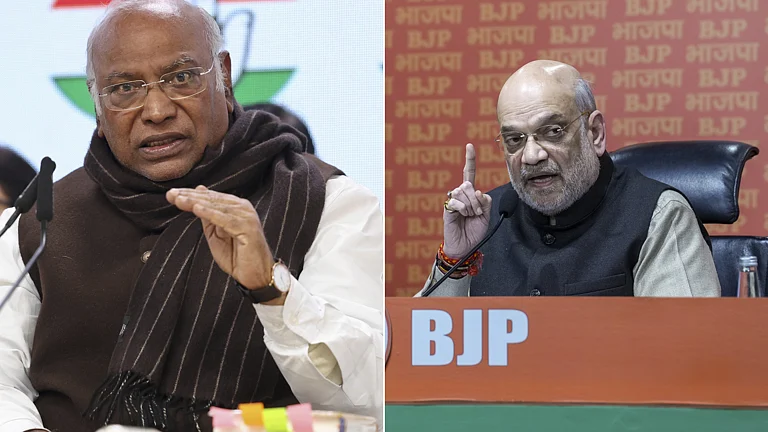
New Delhi, October 9, 2026: Congress president Mallikarjun Kharge on Friday accused the Narendra Modi-led government of promoting monopolies and duopolies across key economic sectors, alleging that its policies favour select business groups at the expense of competition and smaller enterprises.
In a post on X, Kharge claimed that the government's economic policies were allowing a handful of influential corporate groups to gain greater control over the economy. He alleged that this concentration of market power was undermining the principles of economic liberalisation and benefiting the ruling Bharatiya Janata Party (BJP).
Kharge Alleges Corporate Favouritism Under Modi Government
Kharge alleged that the government's economic approach was designed to benefit favoured industrialists while weakening competition across several sectors.
He claimed that the reduction in the number of major market players had created an environment in which a limited number of companies could exercise greater influence over prices, services and market access.
The Congress president also accused the BJP of prioritising political and financial interests over the broader needs of the Indian economy.
Congress Raises Concerns Over Telecom and Aviation Sectors
Citing the telecom industry, Kharge claimed that India had 13 players before 2014, compared with three major private operators currently dominating the market.
He also referred to the aviation sector, alleging that the number of major players had declined from seven before 2014 to two.
Kharge further argued that competition had weakened in sectors such as digital payments, cement and food delivery applications. He alleged that government policies had contributed to the growing concentration of market power in these industries.
These figures and allegations reflect Kharge's claims and should be assessed against current industry data and the definitions used to count market participants.
Kharge Uses ‘Economic Terrorism’ to Criticise BJP Policies
Criticising the government's economic record, Kharge described the BJP's approach as “economic terrorism,” alleging that political and financial interests drove its policies.
He argued that the Congress had played a key role in introducing economic liberalisation in India and accused the BJP of undermining the competitive foundations of that model.
Kharge also expressed concern about the impact of market concentration on micro, small and medium enterprises (MSMEs), claiming that smaller businesses were facing significant difficulties under the current economic environment.
Congress Links Economic Policies to Unemployment Concerns
Kharge alleged that policies favouring large business groups had weakened smaller industries and contributed to employment challenges among young Indians.
He claimed that MSMEs and other small and medium-sized businesses were struggling, limiting their ability to expand operations and create jobs.
The Congress president's remarks add to the ongoing political debate over employment generation, the business environment, market competition and the government's approach to economic growth.
Jebi Mather Raises Questions Over UPI and Corporate Concessions
Separately, Congress MP Jebi Mather criticised what she described as the influence of American interests on India's policy decisions.
Referring to developments involving the US government's suspension of the Permanent Labour Certification Programme, she raised concerns about the potential impact on major Indian IT companies.
Mather also linked her criticism to digital payment policies, including UPI and RuPay, and alleged that policy concessions had benefited major business groups in sectors such as telecommunications and power.
She questioned whether exemptions and regulatory decisions were being applied consistently, alleging that large corporate interests had received preferential treatment.
These remarks represent the Congress party's allegations; the specific claims regarding foreign influence and corporate concessions require independent verification.
Political Debate Over Competition and Corporate Influence
Kharge's criticism comes amid a wider political debate over market concentration, the role of large conglomerates and the condition of smaller businesses in India.
The Congress has argued that stronger competition is necessary to support smaller enterprises, encourage job creation and ensure a more balanced economic environment.
The BJP-led government's economic policies remain a subject of political debate, with questions around market competition, investment, regulation and employment continuing to feature prominently in discussions about India's economic future.